So, according to the press, Mixer will be closing down next month (July 2020).
This gives me an opportunity to finally switch from OBS to the Streamlabs version, with all its extra bells and whistles. Given the main reason for using Restream was to feed to Mixer, Youtube and Twitch at the same time, now I can focus on Twitch, and just need to remember to archive my videos off to Youtube regularly!
let’s see how it goes. Expect to see some changes to the styling, overlays and so on.
So, recently while streaming, I’ve come across games which I would have been extremely aggreived to have spent real money on.
I’m an XBox Game Pass user, which means for a suscription fee, I get access to a variety of games, often for a limited period of time, to play as much as I want. a side benefit of the Game Pass recently is the “Games with Gold” perk, which gives you “free” games, to own as long as you are a member.
All in all, i find the Game Pass (and by extension, Game Pass Ultimate, meaning I get the games on the PC and the XBox combined) extremely good value. As a Streamer, I can pick some game at random, which I may or may not have bought if it weren’t for the Game Pass, and play through it, giving criticism or praise as I go.
A while back, I reviewed a game called “The Sinking City”, which was a Lovecraftian open-ish world game that came out on the Epic Game Store. I had been looking forward to it, being a fan of Lovecraft and Cthulhu style games. In the end, i was sadly disappointed by the glitchy and incomplete open world, with arbitrary boundaries, and very clunky transitions. All in all, I gave up with it after a few hours as just a bad job.
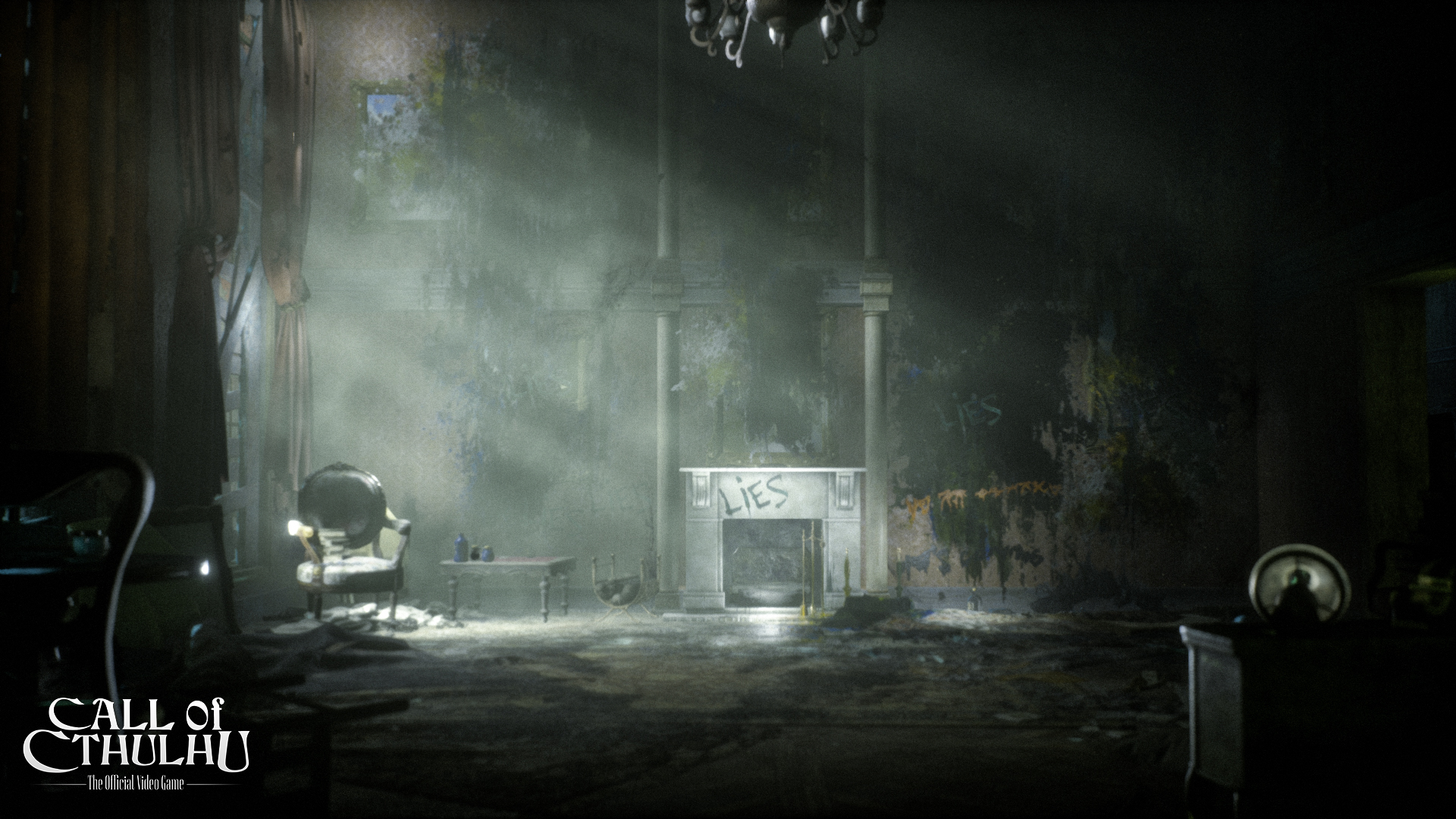
So this is all a very clunky way of saying that when Call of Cthulhu: The Official Videogame came through on the Games with Gold, I was looking forward to it.
And then I actually played it. The game is arranged into a dozen or so chapters, or one could really call them “Scenes”. bits of story which you loosely interact with, but ultimately have to complete to a certain degree to move on in the story. There are no branches to the story that I could see to any amount, although there are a number of decisions which can affect the ultimate ending of the story. along the way you gain Experience Points (XP) by finding books (medical and occult) or by completing tasks/feats along the way. These can be used to tweak some of your skills, a nod to the Pen and Paper RPG of Call of Cthulhu. As the game went by, I came up against some tests and dialogue options which were compromised because of the way I’d spent these points, so ultimately they did affect the ending, but really they didn’t affect getting through the game, if that makes sense.
What I’m getting at, is an “illusion” of effecting the game with the decisions you make, and the way you spend points. One of the reasons I was disappointed in CoC was that there were inconsistencies in some of the dialogue and story after decisions and dialogue I’d gone through. Sometimes contradictory statements which just jarred the whole thing and made it feel less satisfying.
So, Linear game, check. Bad Quality Assurance, check. (also subtitles which didn’t match the v/o. not a deal killer, but small details like that which just highlight bad quality control of a game). Sometimes glitchy graphics and audio, check.
So, Open World or Linear, it doesn’t matter much, you can still end up with crap games. What’s telling is that neither game was produced by a small software house, or a new one. Frogwares (Sinking City), Focus Interactive (CoC) are both experienced houses, but both ended up producing clunkers.
now let’s look at some other games.
Assassin’s Creed: Origins and AC:Odyssey are two of the Assassin’s Creed series’ last (at time of writing) releases by UbiSoft, one of the behemoths of the industry. Both open world games, both non-linear in approach, with high levels of Quality, in Storyline, Production, Graphics, environment and so on. With these games, you can’t heap enough praise on them, with only an occasional “samey” feel to the way you go about clearing areas and locations of baddies. Between either of these games there is a staggering scale to the worlds, with contrasts in terrain, look and feel, but with busy environments with belieavable NPCs populating them. Contrast that with The Sinking City’s randomly appearing and disappearing NPCs which react in no way whatsoever, randomly walk into walls, bouncing off them vacantly and so on. Cut and paste rooms and locations which have no soul or realism to them.
A Plague Tale: Innocence dropped recently onto the XBox Game Pass. While I will wax relentlessly on the Assassin’s Creed open worlds, picking games from the Game Pass results in a more random result, and that includes more linear chapter style games. Now, while I complain about the linearity of CoC:TOV, linearity in itself is not a deal killing sin. It is if it pretends to something else. In the case of A Plague Tale, there is no pretense around the linearity or the direction you are going at any point in time. In a few chapters there are more open areas which allow you either stealth your way through, or you can go a more direct and violent route. What sets Plague Tale apart from CoC is the level of attention to detail. Dialogue, Music, Scripting, and above all the Quality of the game is so many degrees higher. Production QA is quite clearly much better, the tailoring of the soundtrack to events in the game shines so much brighter.
What, then, is so incongruent between these two examples, is that they’re both published by Focus Interactive. I can’t comment on how staff were employed on either project, but Asobo House, producing Plague Tale are on the face of it a smaller operation. at the time of writing this, they’re neither “Premium” priced games on Amazon, both retailing for around £22.
So, what’s the point you’re getting at, AJ?
You got me, I’m not sure. I find it interesting that what we’re expected to be paying against the amount of gameplay we get is rather large, and the level of quality from games appears to be equally wide. With UbiSoft, Origin, Microsoft, and Sony all offering subscriptions now for playing “all you can eat” from limited company libraries, the opportunity to get some good games without shelling out full retail price is now quite a valuable one. The fact that it levels out the field between lower quality filler, and high end epics could be bad for the consumer when looking at the lists presented to them. However, just as the increased number of players in the Video Streaming arena results in paywalls that mean some consumers only willing to subscribe to one or two services leaves them unable to enjoy such-and-such a series (– cough — Mandalorian — cough — ) so too might gamers end up restricting themselves to one software house over another. There’s some convergence going on in the way games are being delivered, only being more complicated by the newer Game Streaming services (such as the aforementioned Sony offering, PlayStation Now).
It disappoints me that the smaller houses really aren’t aspiring to the level of Production Quality that you get in the larger franchises such as Assassin’s Creed. these games raise the bar, and ultimately, the amount gamers are willing to pay for releases they know share that level of polish. Clearly smaller houses such as Asobo can clear that bar, so why do releases like The Sinking City and CoC get put out as they are?
It’s a brave new world. For me, although I will continue to invest in the individual Assassin’s Creed games, the XBox Game Pass does seem to be good for me, with the range of random games that’s left me streaming a goddamn Fishing game and actually enjoying it.